
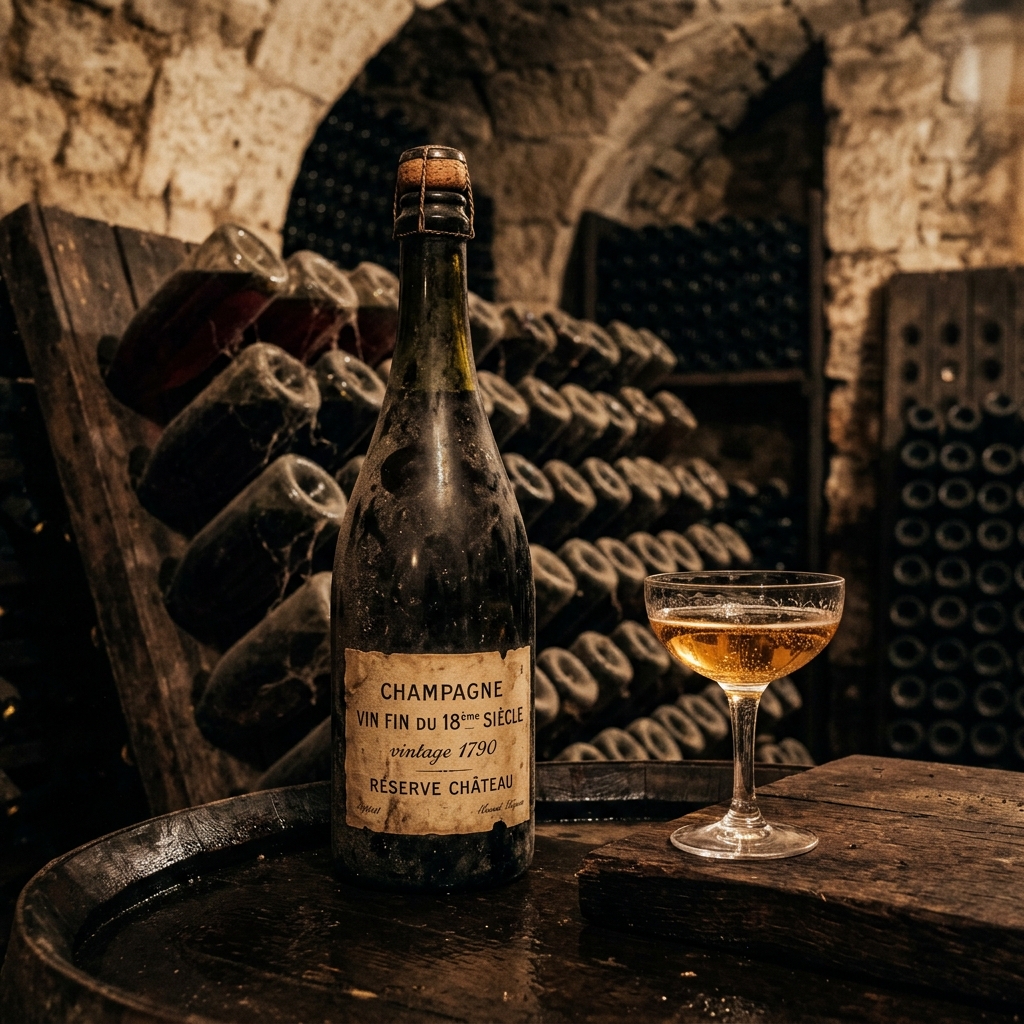
Today, the bubble is the whole point. It is what separates a celebration from an ordinary dinner, what makes a bottle worth photographing before it is worth drinking. But for a large part of its history, that same effervescence was not a selling point — it was considered a defect, and winemakers in the Champagne region spent generations trying to get rid of it.
The problem started with geography. Champagne sits near the northern edge of where grapes can reliably ripen in Europe, and its winters arrive early and hard. Fermentation would stall when the cold set in, leaving sugar and yeast still active inside the barrels. Come spring, as temperatures rose again, fermentation would restart on its own — only this time inside bottles that were already sealed and stored in the cellar.
That unplanned second fermentation produced carbon dioxide with nowhere to go. Pressure built inside the glass until bottles simply gave out, sometimes in chain reactions that could destroy a large portion of a cellar's stock in a single night. Cellar workers wore heavy protective masks while working among the barrels, and the wine earned a nickname that had nothing to do with celebration: "le vin du diable," the devil's wine.
This is also where the popular legend about Champagne gets it backwards. Dom Pérignon, the Benedictine monk and cellar master at the Abbey of Hautvillers in the late 1600s, is often credited with "inventing" Champagne. In reality, a significant part of his work was devoted to the opposite goal — trying to prevent the second fermentation, not create it. He experimented with pressing techniques and blending across plots specifically to produce a stiller, more stable wine, because bubbles at the time were a problem to be solved, not a feature to be sought.
What changed the wine's fortune wasn't a single breakthrough but a shift in taste, and it happened somewhere else entirely: the royal courts of Western Europe. Through the late 1600s and into the 1700s, sparkling wine started showing up at the tables of Versailles and, notably, in England, where it developed a following among aristocrats who saw the effervescence as a mark of novelty and status rather than a flaw. Demand for the "flawed" wine started to grow precisely because of the thing producers had been trying to eliminate.
Technology eventually caught up with demand. English glassmakers, using coal-fired furnaces, had been producing thicker, more durable glass bottles than their French counterparts for other purposes — and that sturdier glass turned out to be exactly what sparkling wine needed to survive its own pressure without shattering. Better corking methods, tied down with wire cages, kept the pressure contained instead of letting it force its way out.
The final piece came in the early 1800s, when houses like Veuve Clicquot refined the process of clarifying the wine without losing its bubbles — the riddling and disgorgement methods that let producers remove dead yeast sediment from the bottle while keeping the fizz intact. What had once been an uncontrolled accident became a repeatable, controllable technique, and Champagne could finally be made consistently clear, stable, and bright.
It's a strange arc for a product now built entirely around a single sensory detail: the thing that once threatened to destroy an entire cellar's inventory in one night became the exact thing people started paying more for. I think there's a lesson in there that goes beyond wine — sometimes what looks like the flaw is just something nobody has figured out how to work with yet.
— José Luis Cadena, Founder · Mexico Tasting Experience